

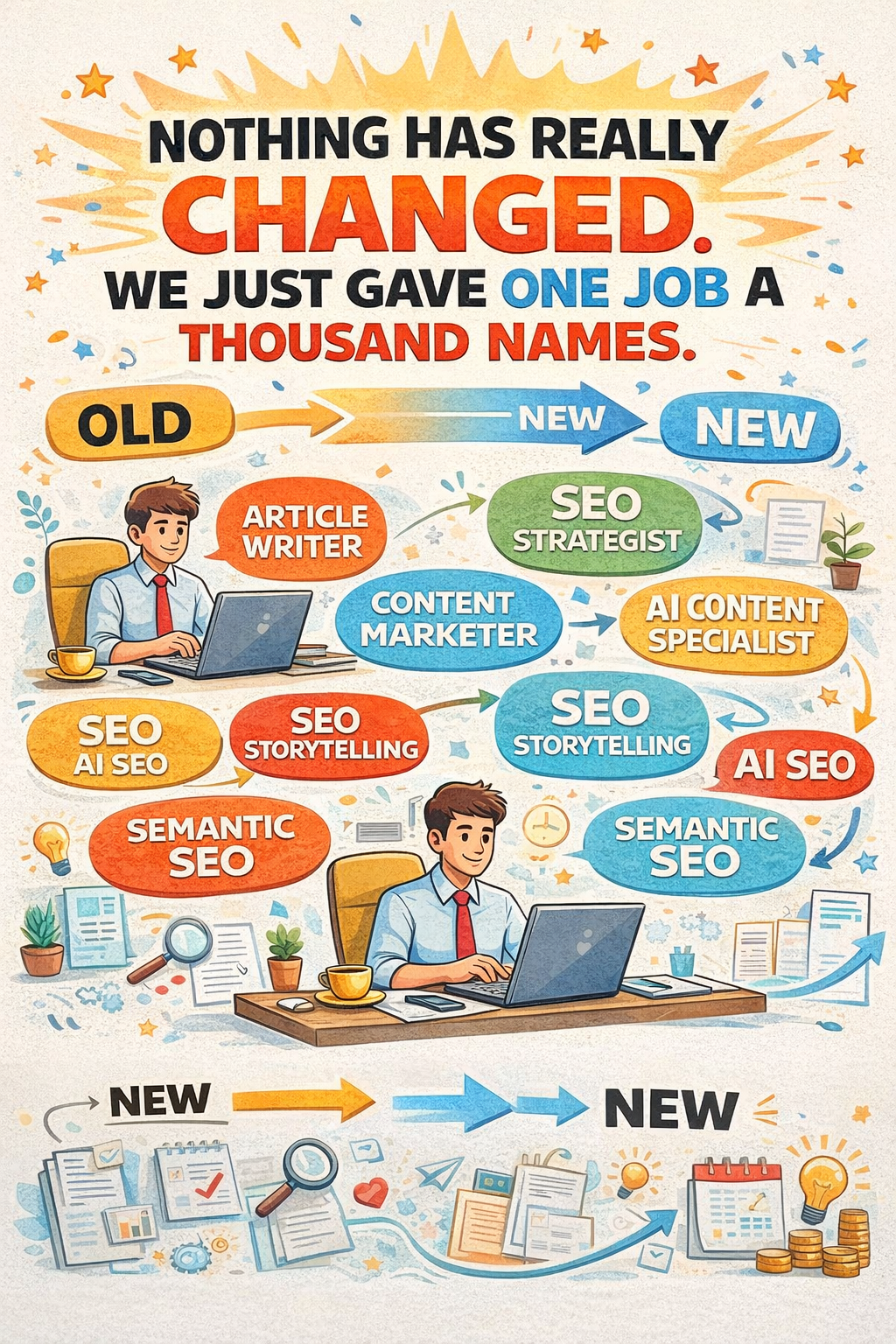
In today’s digital world, it often feels like everything is constantly changing. Every few months there is a new buzzword, a new strategy, or a new technology that promises to revolutionize the way we work. In the field of digital marketing and SEO, terms like AI SEO, semantic SEO, growth hacking, and content optimization are used everywhere. But if we take a step back and look carefully, we may realize something interesting: in many cases, nothing has really changed. We have simply given the same work a thousand different names.
For example, search engine optimization (SEO) has always been about one basic idea—helping people find useful information online. Years ago, marketers focused on keywords, writing articles, and building links to help websites rank on search engines. Today, people talk about AI-driven strategies, machine learning tools, and advanced algorithms. While the tools may be more advanced, the core goal remains the same: create valuable content that answers people’s questions.
The same pattern can be seen in many other industries. A few years ago, writing articles for websites was simply called content writing. Today it might be called content strategy, AI-assisted writing, content marketing, or SEO storytelling. The work itself is still about understanding the audience and creating meaningful information. The names have changed, but the fundamental purpose has not.
Technology has definitely improved how we perform these tasks. Artificial intelligence tools can help with research, idea generation, and data analysis much faster than before. Automation tools can handle repetitive tasks that once took hours. However, the human element—creativity, strategy, and understanding the audience—remains just as important as it always was.
Another reason we see so many new terms is marketing itself. Businesses and professionals often introduce new terminology to highlight innovation and attract attention. When a concept is given a new name, it can feel fresh and exciting, even if the underlying principles are familiar. This is not necessarily a bad thing, but it can sometimes create the illusion that everything is completely different from the past.
In reality, progress usually happens through gradual improvement rather than sudden transformation. The fundamentals stay the same while the tools become better. In SEO, for instance, search engines have become smarter, but they still prioritize relevant, helpful, and trustworthy information. The strategy that worked in the past—understanding your audience and delivering value—still works today.
So when we hear about the latest trend or buzzword, it is useful to remember that the foundation of good work rarely changes. Whether it is called SEO, AI SEO, or something else entirely, the real task remains the same: create quality, solve problems, and communicate clearly.

Leave a Reply